Open for the fast read before you dive into the full article.
Flatbed is the standout of the 2026 freight market, with spot rates near $3.77 a mile well ahead of van and reefer, but thinned capacity since the downturn leaves the segment sensitive to a handful of large projects.
The demand is concentrated in a few capital-heavy engines, led by data-center construction, which topped $50 billion in April and has roughly tripled since 2022, with grid and energy capex, Permian drilling and domestic steel behind it.
Flatbed's strength looks cyclical. The data-center and AI build-out it leans on depends on continued investor funding as costs and depreciation climb, while the construction cycle that traditionally drives flatbed fades.
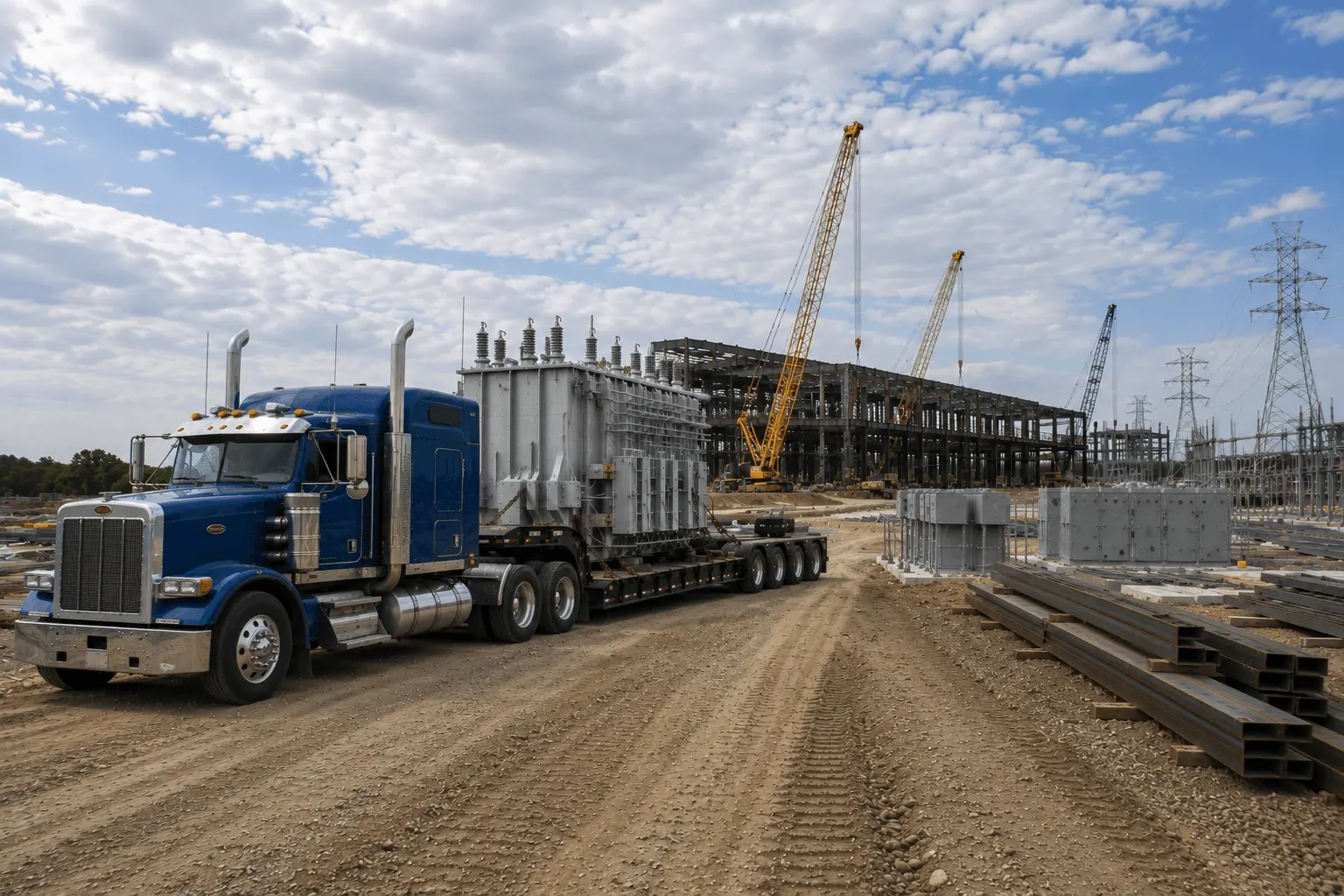
Some of flatbed trucking's busiest lanes this year end at a construction site the size of a small town. On the edge of Phoenix or Atlanta or Columbus, the steel frame of a data center climbs a few hundred yards from a substation built from scratch to feed it. Through the gate, all day, come the flatbeds: structural steel, switchgear, generators, transformers so large a single one fills a trailer. Multiply that site by a few hundred across the country and you have a good part of the reason flatbed has been the standout of the 2026 freight market, well ahead of dry van and reefer while the rest of it grinds along.
The rate line backs it up. DAT's national flatbed rate sits near $3.77 a mile on the spot market, with contract a little higher at $3.87, both well above where the segment spent the long downturn. Strength like that usually means the industrial economy has turned. This time it mostly hasn't. Flatbed's run rests on a short list of demand sources, and the base under it is narrower than the rate line suggests.
Where flatbed actually is
Start with the gap between flatbed and everything else. Through the spring, flatbed spot rates and load-to-truck ratios climbed while van and reefer cooled, and flatbed rates are running well above their five-year average. For a segment that spent three years in the same freight recession as everyone else, that is a real break from the pack.
Flatbed spot still sits below contract, $3.77 against $3.87. That is the normal order, and it is the reverse of what hit dry van earlier this year, when rejected loads pushed shippers onto a spot market that had climbed above their contracted rates. Flatbed is tight, but it is absorbing the tightness in an orderly way, and the panic pricing has stayed away.
Supply is part of that story. Flatbed capacity thinned during the downturn the same way van and reefer did, as owner-operators and small fleets parked specialized trailers that are expensive to leave idle. With fewer decks working, it takes only a few large sources pulling at once to tighten the whole segment.
Four engines are doing most of the work, and all of them are big, capital-heavy and concentrated.
Data centers are the loudest. Spending on data-center construction topped $50 billion for the first time in April, about triple its level in 2022, on Census Bureau figures that now track the category on its own. A data center is a flatbed customer before it is a server farm: structural steel, switchgear, transformers, generators and cooling units all arrive on a deck, and a single transformer can fill a trailer.
Behind the buildings sits the power to run them. S&P Global puts U.S. utility capital spending near $1.3 trillion across 2026 through 2030, most of it chasing the electricity demand the data centers create. Transmission structures, substation transformers and turbine components are flatbed freight, and that spending is only beginning to move.
Energy in the field is the third pull. As Permian rig counts have recovered, flatbed demand and rates in the basin have come back with them, carrying pipe, sand and equipment across West Texas and New Mexico.
Stay close to the market
Get Rig Load Report in your inbox
Weekly freight market analysis, new markets and fresh commentary when it matters.
Then there is the steel itself. U.S. steel output is running about 5% above last year, and with Section 232 at 50%, imported steel has dropped sharply. A larger share of the steel that moves is now domestic, which shifts flatbed demand off the import and port lanes and onto the lanes running out of domestic mills.
What's not
The case for caution is in what is missing from that list. The construction cycle that traditionally drives flatbed is fading as higher financing costs weigh on commercial and residential work, and flatbed is leaning on megaprojects while its bread-and-butter base softens.
Reshoring, the other story behind the flatbed bull case, is still more announcement than freight. Eli Lilly's roughly $27 billion domestic manufacturing plan is real and will move steel for years. But an ISM survey found 64% of firms had no plans to reshore at all, against 36% planning to or already doing it. The factory-building wave is concentrated in a few names and a few sectors.
Even the tariff cuts both ways. The same 50% duty that fills domestic-mill lanes empties the import lanes that used to run off the ports, so the net effect on flatbed demand depends on the lane. A carrier working out of a Gulf port that handled imported steel is having a different year from one working out of a mill in the Midwest.
The biggest engine is a cycle
Put those together and the two biggest engines are really a single bet. Data centers and the power build-out behind them both ride on artificial intelligence, placed at a scale that has the shape of a cycle. The largest hyperscalers are on track to spend more than $600 billion on data centers and AI infrastructure in 2026, more than double 2024, and they are funding a growing share of it with debt. Amazon's free cash flow has already swung negative this year. The depreciation is the uncomfortable part. AI hardware loses value fast, which leaves the group carrying annual depreciation near $400 billion, more than its combined profit last year. Spending at that intensity holds up only as long as investors keep funding it.
The clearest read on how late the cycle runs is the IPO calendar. SpaceX priced the largest public offering in history this month, a $75 billion raise. Anthropic filed to go public on June 1 at a $965 billion valuation, and OpenAI is expected to follow. The biggest debuts of a boom tend to cluster near its top. What that says is less about timing than about temperature: how hot the cycle has run, and how much of the build-out now depends on the enthusiasm continuing.
For the near term, the risk is the opposite of a bust. Data-center demand is still outrunning the industry's ability to build. Most of the capacity planned for 2026 has yet to break ground, and by some counts 30% to 50% of it will slip to 2028 on power and permitting limits. For flatbed, that means the freight stretches out rather than vanishes. The cliff, if it comes, is a year or more away.
When the cycle does turn, though, flatbed is the freight most exposed to it. Data-center construction is discretionary capital, the first line cut when financing tightens or the AI trade cools, and flatbed is what hauls the steel, transformers and switchgear it consumes. The pullback would reach flatbed before van or reefer, because flatbed is the most construction-levered of the three. A deeper, AI-led downturn would work through to broader goods demand later, through weaker hiring and capital spending, and van and reefer would catch it then. Flatbed leads the industrial cycle in both directions.
None of this calls a top in 2026. Goldman Sachs and others read the same figures as an infrastructure supercycle rather than a bubble, and the AI skeptics have been early before. The reasonable assumption is that flatbed's strength rides the cycle, and cycles turn. The engines are real and may run for another year or several. They are also concentrated in one debt-financed boom, and the question is not whether that cycle turns, only when.
What to watch
That makes flatbed a harder call than the rate line suggests, and the signals that matter are specific ones.
A carrier deciding whether to shift capacity or buy a trailer into flatbed is really betting on a few inputs: data-center starts, announced utility capex, steel output, the status of Section 232, and further out, whether the AI build-out keeps its footing. Those are the things to track. What is lifting flatbed is specific, and largely separate from the national freight cycle.
For brokers and shippers, the strong lanes cluster around domestic mills, data-center build sites, the Permian and the ports that still bring in machinery and industrial equipment. The import-steel lanes have already cooled. This is a market to price lane by lane.
Durability is a year-over-year question. Flatbed always softens as the spring and summer project season gives way to the fourth quarter, so a weak Q4 on its own proves nothing. The real test is whether Q4 2026 holds against Q4 2025. If it does, the capex engines are still running. If it gives way, so did the narrow base.
The harder question sits on the far side of the peak, which is why we opened a market on the Q4 national flatbed rate. The fourth quarter is when the seasonal tailwind drops out and the four engines have to carry flatbed on their own. A reading that holds near today's levels says the data-center and grid build-out is doing the work. A soft one says the spring was the high, and the base was as narrow as it looked. For the tail under all of it, a second market asks whether data-center construction spending turns down before 2028.