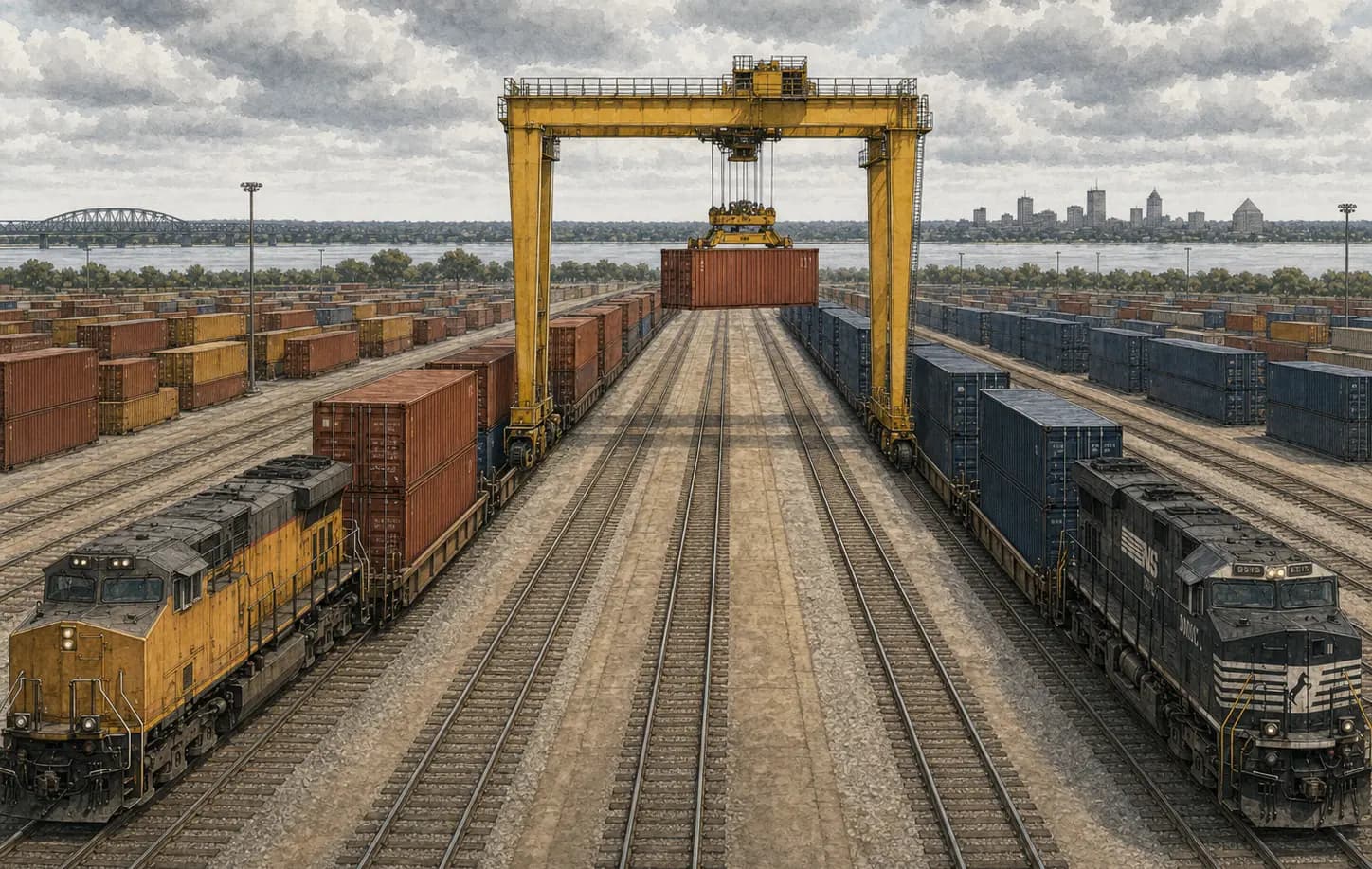
What a single-line transcontinental does to trucking
Union Pacific and Norfolk Southern's amended merger application projects 2.1 million truckloads a year shifting modes and $3.5 billion in annual shipper savings. Which lanes re-price, and how soon will procurement teams start treating the threat as part of their planning baseline?
Open for the fast read before you dive into the full article.
Union Pacific and Norfolk Southern's merger could shift 2.1 million truckloads to rail annually, resulting in $3.5 billion in shipper savings.
The merger aims to eliminate the operational complexities and costs associated with multi-carrier services, making rail more competitive against over-the-road trucking.
Key lanes likely to benefit from the merger include West Coast imports to the Southeast and LA-to-Memphis routes, which currently rely on costly interchanges.
The merger's approval process is lengthy, with a final decision expected by late 2027 or early 2028, impacting shippers' planning timelines.
Big-box retailers like Walmart and Target are expected to be the first to shift freight to rail if the service improves post-merger.
A container that lands at the Port of Long Beach in early May, bound for an Atlanta distribution center, will spend most of its journey on a train. The first leg is straightforward. Union Pacific picks it up at the port, runs it east through Texas and Arkansas, and delivers it to an interchange in Memphis. The second leg is where the math gets harder.
Norfolk Southern picks it up there, but not immediately. The box sits in an interchange yard for a day or two, gets re-coupled to an NS train, and only then resumes the run east. The dwell adds time. The two operating systems add variance. The handoff adds paperwork and a pricing premium for the operational complexity of a multi-carrier service. For shippers who live by transit-time guarantees, that variance is often what's keeping similar boxes on a truck instead.
UP and NS aren't being subtle about why. The amended application projects roughly $2.75 billion in annual synergies for the combined railroad, about $1 billion of which comes from cost and productivity savings. The rest is revenue, built on converting freight from trucks to rail.
The carriers estimate that 2.1 million trucks a year would shift modes if the merger goes through, with shippers capturing an estimated $3.5 billion annually in savings from the lower rail-cost basis. The combined railroad is underwriting an $85 billion deal partly on truck-to-rail conversion, and the carriers are openly arguing that part of the case to STB. The freight-side question is which truckloads, on which lanes, and how soon procurement teams start treating the threat as part of their planning baseline.
The procedural runway
What the refiling actually does is procedural. STB determined in January that the December application was missing required exhibits, including Schedule 5.8 on materially burdensome conditions, the full merger agreement and related contracts. The amended version filed April 30 is the corrected case, with the additional documentation and market-share modeling STB asked for, plus updated traffic data drawn from all six Class I railroads rather than sample data. After STB rules on completeness, formal review begins under the post-2001 enhanced merger standards Congress wrote specifically because the 1996 UP-Southern Pacific merger had spiraled into operational chaos that the conditions package failed to anticipate.
UP-NS would be the first major Class I merger reviewed under those enhanced standards. The CPKC combination that closed in 2023 was approved under pre-2001 grandfathering for smaller carriers. Under the enhanced standards, even a clean filing puts a final STB decision in late 2027 or early 2028. UP and NS are still publicly targeting a close in the first half of 2027, which is the kind of date executives put in pitch decks. The procedural calendar will almost certainly slide it.
The next checkpoint is acceptance for review. STB has set May 8 as the deadline for comments on the amended application's completeness, with applicant replies due May 12 and a completeness ruling to follow. Acceptance doesn't approve the merger. It converts the threat from theoretical to scheduled.
What the interchange costs today
What the merger would actually change for freight is in the math of what an interchange costs today.
A box moving on rail between Western and Eastern networks isn't paying just for the dwell at the interchange yard, though that's the most visible cost. The shipper is also paying a premium for the operational complexity of a multi-carrier service product, and absorbing a transit-time variance penalty that comes from stitching two railroads' service standards together. The combination is what makes intermodal lose to OTR on certain east-west lanes today. The linehaul math would otherwise favor rail. The handoff is what tips it.
Stay close to the market
Get Rig Load Report in your inbox
Weekly freight market analysis, new markets and fresh commentary when it matters.
Take the interchange away and the comparison shifts. The same box moves on one operating system, with simpler pricing and a more predictable transit clock. None of this turns intermodal into a substitute for time-critical freight or perishables. But the slice of east-west long-haul where the handoff was the cost driver, and that's a meaningful slice, re-prices in intermodal's favor. The shippers who had been quietly running modal-substitution math for years and waiting for the rail product to get good enough have just been told it's coming.
The lanes most exposed
The lanes most exposed to that re-pricing are knowable. The strongest case is West Coast imports moving to the Southeast — the Long Beach-to-Atlanta corridor and its variants — because that traffic today routes through a UP-to-NS interchange and is dense enough to support dedicated single-line service from day one. LA-to-Memphis is similarly exposed when the destination market is the Mid-South. Texas, on UP's network, gains direct rail access to NS's Southeastern markets without a Class I handoff. Each of those lanes today carries a meaningful share of OTR long-haul that has chosen rate stability over what intermodal currently offers, and that choice looks different if the rail product changes.
The shippers most likely to flex their freight first are big-box retail importers — Walmart and Target lead the category, both already intermodal-heavy with enough volume to negotiate single-line service contracts as soon as one is offered. Consumer packaged goods importers landing on the West Coast and moving east are the next tier. JIT auto, perishables and other time-critical categories don't move materially even if the rail product improves; the modal-shift story doesn't apply to freight that's on a truck because nothing else can keep up.
Conditions are coming
None of this happens in a regulatory vacuum. Every Class I merger reviewed under modern STB standards has come with a thick package of structural conditions, and UP-NS will not be the exception. Trackage rights for BNSF and CSX over key lanes preserve some competitive alternative for shippers, gateway preservation at Chicago and other major junctions maintains open routing for non-merged carriers, and service-level reporting requirements give STB an enforcement hook against the kind of operating breakdown the post-2001 standards were written to prevent.
The opposition coalition shapes how aggressive those conditions get. Agriculture is already organized: the American Farm Bureau and various grain shipper groups have argued publicly that consolidation reduces rail competition for ag freight, and STB has historically been responsive to that constituency. Competing carriers are organizing too. Canadian National said April 30 that the amended application has not "materially improved" the case in ways that address the merger's competitive harms, and the May 8 comment window gives other Class Is a formal venue to register objections. Whether organized opposition makes the deal harder to approve or simply produces a heavier conditions package is the open question.
The modal-shift thesis survives even a heavy conditions package. Trackage rights preserve competitive alternatives but don't undo the operational simplicity the merged carrier captures. The merged railroad still controls the single-line product, and it still gets to underprice intermodal against OTR on the lanes where the handoff was the cost driver. Conditions narrow what UP-NS extracts from the merger. The economic advantage on the exposed lanes survives.
The defensive question
The strategic problem the merger creates for the other two big Class Is is the kind of problem that drives defensive consolidation. BNSF, owned by Berkshire Hathaway, is the only other major Western Class I. CSX is the other big Eastern carrier. Either would be watching its largest competitor offer a single-line transcontinental product it can't match. Whether they actually merge in response is a separate question. Berkshire's ownership structure complicates BNSF's strategic options, and CSX's governance has its own constraints. But the pressure to consolidate goes from theoretical to acute the moment STB accepts the UP-NS application for review.
For trucking, the difference between facing one transcontinental rail competitor and facing two is a big deal. One transcontinental concentrates the modal-shift competitive pressure on UP-NS-served lanes. Two transcontinentals spread that pressure structurally across the whole east-west long-haul market. Shippers who anticipate the two-transcontinental scenario have more procurement leverage in 2026 and 2027 than shippers who don't.
What to do this quarter
The shipper-side decision is the most asymmetric. A shipper running east-west long-haul in volume has reason to start running modal-shift math on those lanes now, not because the merger closes in 2027 but because the threat of it is already a card to play in current contract negotiations. A 2026 RFP that locks in a multi-year commitment without an opt-out on the most exposed lanes is a less defensible procurement decision than the same RFP run with the merger as a known background variable. The procurement teams that run that math first get the better contracts.
The broker side is mostly downside. A book heavy in east-west long-haul has a modal-shift exposure that didn't exist a year ago. Intermodal capacity contracting, where applicable, matters more than it used to. So does diversification into regional and less rail-substitutable freight. Brokers who treat the merger as someone else's problem are the ones holding the worst-positioned books in 2027.
OTR carriers face the cleanest strategic choice. Either lean into east-west long-haul and compete on what rail can't easily replicate, like service quality and time-sensitivity, or lean out and reposition capacity toward freight without a credible rail alternative. The right answer depends on the carrier's existing network. The choice doesn't wait on the STB.
The markets
The Rig Load market closest to this story prices the proximate question: will the STB accept the UP-NS merger application for review in 2026? After January's rejection, the answer now hinges on the May 8 comment window and STB's completeness ruling that follows. That binary likely resolves within weeks, and it's the cleanest leading indicator on whether the merger reaches formal review at all.
A new companion market opening with this piece prices the second-order question: will BNSF and CSX announce a defensive merger of their own before December 31, 2027? A reader who thinks UP-NS gets through the STB process is forced to take a view on whether the rest of the industry consolidates in response. That market is where the two-transcontinental scenario gets priced.
Beyond the deal itself, modal shift would show up first on the capacity-side prints. If intermodal pricing structurally improves on east-west lanes, the OTR markets pricing tender rejections and contract rates eventually feel it — though that's a several-quarter lag, not a near-term effect.
STB process measures in years. Freight procurement runs on a faster clock, and the next round of contracts will price this in before STB rules.