The first formal review of the trade deal governing $354 billion in cross-border freight kicked off this week. The industry has bigger problems right now.

AI-generated narration
Preparing audio...
The first formal review of the trade deal governing $354 billion in cross-border freight kicked off this week. The industry has bigger problems right now.

AI-generated narration
Preparing audio...
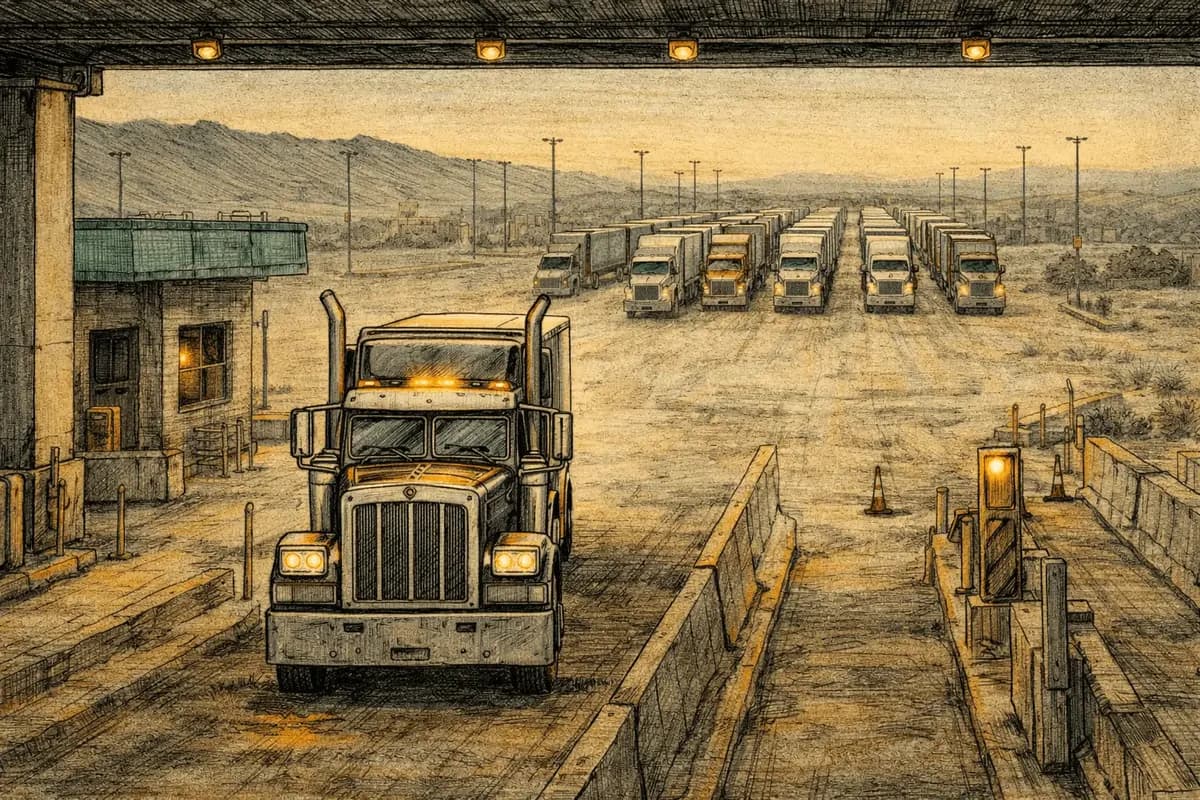
Before dawn on any given weekday, the line of trucks waiting to cross the World Trade Bridge in Laredo already stretches for miles. Twenty thousand commercial vehicles will make the crossing today, same as yesterday, carrying auto parts and electronics and produce worth close to a billion dollars. The drivers idling in that line are thinking about fuel costs, border wait times, maybe the dispatcher who shorted them on detention pay. None of them are thinking about Article 34.7 of the United States-Mexico-Canada Agreement.
On March 18, Mexico's Economy Secretary Marcelo Ebrard sat down with U.S. Trade Representative Jamieson Greer in Washington to formally launch the first joint review of that agreement. The July 1 deadline is just over 100 days away. The freight industry has barely noticed — $5 diesel and the Iran crisis have most of the attention. But depending on what happens by July 1, the USMCA could be extended for 16 more years, renegotiated with tighter rules that reshape automotive supply chains, or placed on a 10-year countdown toward termination — and each of those paths puts different pressure on the rates, lanes and capacity planning that cross-border carriers are building their 2027 budgets around.
The USMCA includes a review mechanism that no previous U.S. trade agreement has ever had. Every six years, the three countries' trade ministers sit down and decide the agreement's future. The first checkpoint is July 1, 2026.
The ministers have three options. They can extend the deal for another 16 years and push the next review to 2032. They can negotiate changes and then extend. Or any one country can refuse to sign off, which triggers mandatory annual reviews and starts a 10-year clock. If nobody blinks by 2036, the agreement dies.
That last option sounds extreme, but Trump has been flirting with it. At Ford's Dearborn plant, he told workers he wants "a much better deal" and wants to "take advantage, now, of the car industry." He has called the pact both "irrelevant" and "great for all countries," sometimes in the same appearance. The Detroit News reported in February that he privately asked aides why he shouldn't withdraw entirely from a deal he himself negotiated.
Mexico wants a clean extension and no drama. President Sheinbaum's stated goal is to guarantee permanence and "avoid annual reviews." Ebrard has talked about "firmness and composure," which is diplomatic code for: please don't blow this up. Canada is harder to read. Ontario's auto sector has warned it could lose C$2.9 billion in investment from review-related uncertainty alone, and Prime Minister Carney has called for a "robust" process without saying what he actually wants out of it.
Laredo is the country's busiest port of entry by trade value, ahead of every seaport and airport in the country. Six million trucks cross there annually. Ninety-seven percent of Port Laredo's trade is with Mexico.
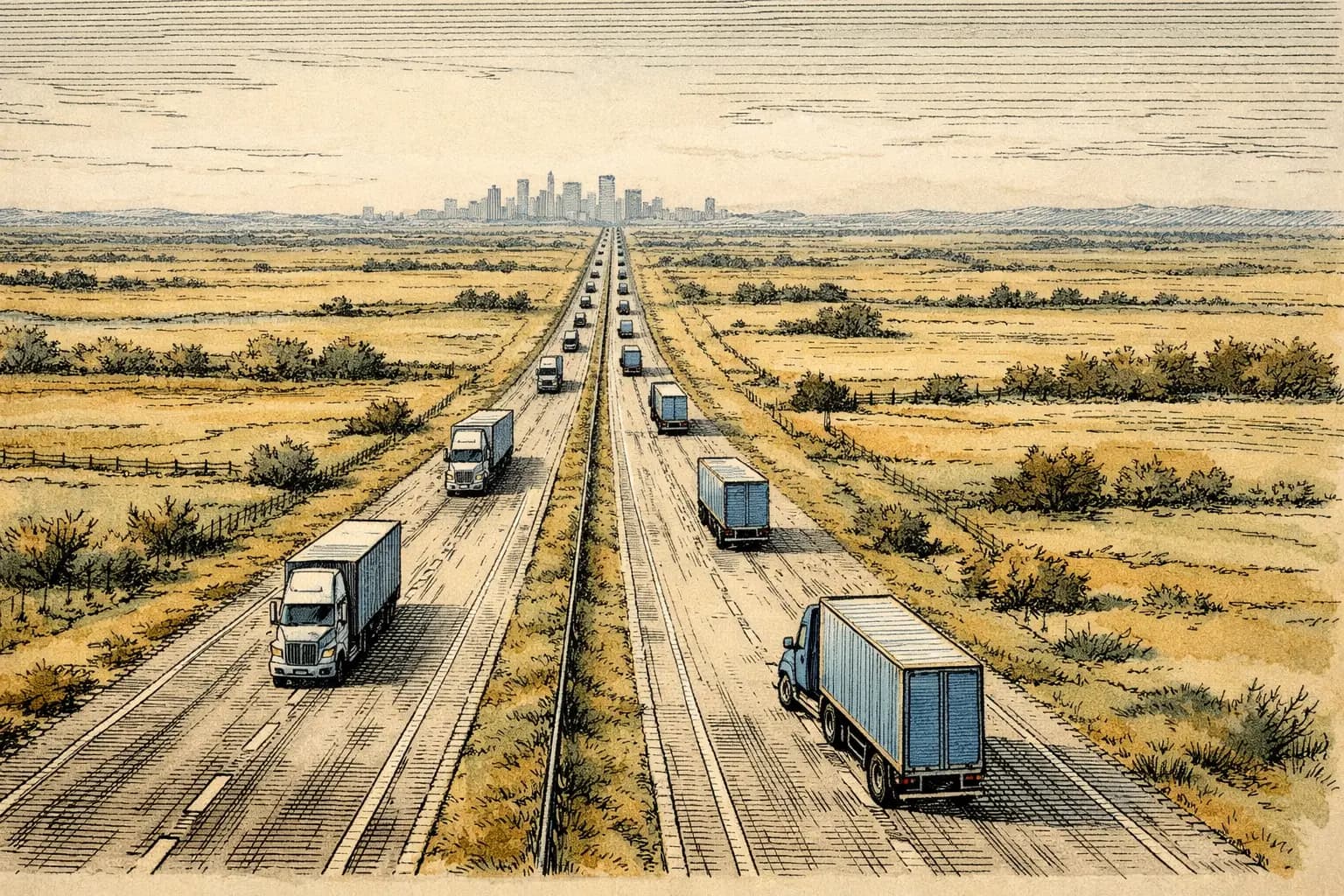
The single biggest category moving through Laredo is automotive parts. Mexico sends 86.9% of its auto parts production to the United States and buys back 49.4% of all U.S. auto parts exports. More than 600 Mexican companies are Tier 1 suppliers to major OEMs. And these parts don't cross the border once. An engine block might start as U.S.-forged steel, get machined in Monterrey, return to an assembly line in San Antonio, and ride back across as part of a finished vehicle. Each leg is a truckload. The I-35 and I-10 corridors run on this back-and-forth.
Will the U.S. withhold USMCA renewal at the July 2026 review?
Check the live market view, review the current consensus, and make your own forecast.
The broader U.S.-Mexico freight market is projected to grow from $247.6 billion in 2025 to $321 billion by 2031. FreightWaves has called Mexico freight the U.S. trucking market's "biggest stabilizer" heading into 2026.
The loudest policy argument for renegotiation is China. USMCA's current automotive rules of origin require 75% regional value content for passenger vehicles, meaning at least three-quarters of a car's value must come from North America. That leaves a 25% window, and Chinese manufacturers have been threading it. Chinese investment in Mexico's auto sector jumped 77% to $3.9 billion, mostly in factories that build components just over the threshold needed to ship duty-free into the United States under USMCA.
Mexico has already tried to get ahead of this. In September, it imposed a 50% tariff on Chinese imports in several categories. But the political math in Washington runs hotter. Greer's March 18 statement instructed negotiators to focus on "reducing dependence on imports from outside the region" and "strengthening rules of origin." Diplomatic language for tightening the China restrictions.
But the existing rules are already so burdensome that some suppliers have given up on compliance entirely. The 75% regional value content threshold, combined with a labor value content rule requiring 40-45% of vehicle value to come from workers earning at least $16 per hour, creates a paperwork load that smaller suppliers can't justify. A Federal Reserve analysis found that some just label their parts "non-originating" and pay the tariff rather than prove they qualify for duty-free treatment. The compliance costs are high enough to suppress the trade data itself. Push the threshold higher or add Chinese-component exclusions, and the number of qualifying shipments could shrink even as physical volumes grow.
Any other year, this would be a straightforward policy story. Not so this one.
The Iran war has pushed diesel above $5 a gallon. Carriers running border lanes are absorbing fuel costs that were $1.40 lower a month ago, the Strait of Hormuz remains closed to most commercial traffic, and auto parts stranded in the Persian Gulf are already disrupting North American production schedules. Try negotiating a six-year trade framework when nobody can tell you what diesel will cost next month.
The tariff calendar makes it worse. The Section 122 bridge tariffs that replaced the IEEPA tariffs after the Supreme Court struck them down are set to expire around July 24. That's days after the USMCA review deadline. USMCA-compliant goods are currently exempt from the 10% bridge tariff, which gives every manufacturer on the border a strong reason to keep qualifying. The expiration also creates leverage: if the administration wants to pressure Mexico and Canada at the review table, it can threaten to replace the bridge tariffs with something more targeted once the statutory window closes.
And then there's November. Michigan, where more cars are built than anywhere else in the country, has an open Senate seat after Gary Peters announced his retirement. No trade decision between now and November will be made without someone calculating the electoral math. A clean, quiet extension of the USMCA plays well in boardrooms but doesn't make the evening news. A theatrical renegotiation does.
If the review produces stricter origin requirements, the effect on border trucking runs opposite to what you'd expect. More North American content requirements mean more North American sourcing, which means more trips across the border as components bounce between plants to meet the threshold. When USMCA replaced NAFTA and raised the automotive content requirement from 62.5% to 75%, cross-border freight demand went up, not down. Raise it again, or add Chinese-component exclusions that force supply chain redesigns, and you add truck moves to a border infrastructure that's already at capacity.
Subscribe to Rig Load Report
Get weekly freight market analysis in your inbox.
Rig Load is an independent platform for exploring expectations around freight-related outcomes. Content is for informational purposes and does not constitute professional advice.
Rig Load. All rights reserved.
Before dawn on any given weekday, the line of trucks waiting to cross the World Trade Bridge in Laredo already stretches for miles. Twenty thousand commercial vehicles will make the crossing today, same as yesterday, carrying auto parts and electronics and produce worth close to a billion dollars. The drivers idling in that line are thinking about fuel costs, border wait times, maybe the dispatcher who shorted them on detention pay. None of them are thinking about Article 34.7 of the United States-Mexico-Canada Agreement.
On March 18, Mexico's Economy Secretary Marcelo Ebrard sat down with U.S. Trade Representative Jamieson Greer in Washington to formally launch the first joint review of that agreement. The July 1 deadline is just over 100 days away. The freight industry has barely noticed — $5 diesel and the Iran crisis have most of the attention. But depending on what happens by July 1, the USMCA could be extended for 16 more years, renegotiated with tighter rules that reshape automotive supply chains, or placed on a 10-year countdown toward termination — and each of those paths puts different pressure on the rates, lanes and capacity planning that cross-border carriers are building their 2027 budgets around.
The USMCA includes a review mechanism that no previous U.S. trade agreement has ever had. Every six years, the three countries' trade ministers sit down and decide the agreement's future. The first checkpoint is July 1, 2026.
The ministers have three options. They can extend the deal for another 16 years and push the next review to 2032. They can negotiate changes and then extend. Or any one country can refuse to sign off, which triggers mandatory annual reviews and starts a 10-year clock. If nobody blinks by 2036, the agreement dies.
That last option sounds extreme, but Trump has been flirting with it. At Ford's Dearborn plant, he told workers he wants "a much better deal" and wants to "take advantage, now, of the car industry." He has called the pact both "irrelevant" and "great for all countries," sometimes in the same appearance. The Detroit News reported in February that he privately asked aides why he shouldn't withdraw entirely from a deal he himself negotiated.
Mexico wants a clean extension and no drama. President Sheinbaum's stated goal is to guarantee permanence and "avoid annual reviews." Ebrard has talked about "firmness and composure," which is diplomatic code for: please don't blow this up. Canada is harder to read. Ontario's auto sector has warned it could lose C$2.9 billion in investment from review-related uncertainty alone, and Prime Minister Carney has called for a "robust" process without saying what he actually wants out of it.
Laredo is the country's busiest port of entry by trade value, ahead of every seaport and airport in the country. Six million trucks cross there annually. Ninety-seven percent of Port Laredo's trade is with Mexico.
The single biggest category moving through Laredo is automotive parts. Mexico sends 86.9% of its auto parts production to the United States and buys back 49.4% of all U.S. auto parts exports. More than 600 Mexican companies are Tier 1 suppliers to major OEMs. And these parts don't cross the border once. An engine block might start as U.S.-forged steel, get machined in Monterrey, return to an assembly line in San Antonio, and ride back across as part of a finished vehicle. Each leg is a truckload. The I-35 and I-10 corridors run on this back-and-forth.
Will the U.S. withhold USMCA renewal at the July 2026 review?
Check the live market view, review the current consensus, and make your own forecast.
The broader U.S.-Mexico freight market is projected to grow from $247.6 billion in 2025 to $321 billion by 2031. FreightWaves has called Mexico freight the U.S. trucking market's "biggest stabilizer" heading into 2026.
The loudest policy argument for renegotiation is China. USMCA's current automotive rules of origin require 75% regional value content for passenger vehicles, meaning at least three-quarters of a car's value must come from North America. That leaves a 25% window, and Chinese manufacturers have been threading it. Chinese investment in Mexico's auto sector jumped 77% to $3.9 billion, mostly in factories that build components just over the threshold needed to ship duty-free into the United States under USMCA.
Mexico has already tried to get ahead of this. In September, it imposed a 50% tariff on Chinese imports in several categories. But the political math in Washington runs hotter. Greer's March 18 statement instructed negotiators to focus on "reducing dependence on imports from outside the region" and "strengthening rules of origin." Diplomatic language for tightening the China restrictions.
But the existing rules are already so burdensome that some suppliers have given up on compliance entirely. The 75% regional value content threshold, combined with a labor value content rule requiring 40-45% of vehicle value to come from workers earning at least $16 per hour, creates a paperwork load that smaller suppliers can't justify. A Federal Reserve analysis found that some just label their parts "non-originating" and pay the tariff rather than prove they qualify for duty-free treatment. The compliance costs are high enough to suppress the trade data itself. Push the threshold higher or add Chinese-component exclusions, and the number of qualifying shipments could shrink even as physical volumes grow.
Any other year, this would be a straightforward policy story. Not so this one.
The Iran war has pushed diesel above $5 a gallon. Carriers running border lanes are absorbing fuel costs that were $1.40 lower a month ago, the Strait of Hormuz remains closed to most commercial traffic, and auto parts stranded in the Persian Gulf are already disrupting North American production schedules. Try negotiating a six-year trade framework when nobody can tell you what diesel will cost next month.
The tariff calendar makes it worse. The Section 122 bridge tariffs that replaced the IEEPA tariffs after the Supreme Court struck them down are set to expire around July 24. That's days after the USMCA review deadline. USMCA-compliant goods are currently exempt from the 10% bridge tariff, which gives every manufacturer on the border a strong reason to keep qualifying. The expiration also creates leverage: if the administration wants to pressure Mexico and Canada at the review table, it can threaten to replace the bridge tariffs with something more targeted once the statutory window closes.
And then there's November. Michigan, where more cars are built than anywhere else in the country, has an open Senate seat after Gary Peters announced his retirement. No trade decision between now and November will be made without someone calculating the electoral math. A clean, quiet extension of the USMCA plays well in boardrooms but doesn't make the evening news. A theatrical renegotiation does.
If the review produces stricter origin requirements, the effect on border trucking runs opposite to what you'd expect. More North American content requirements mean more North American sourcing, which means more trips across the border as components bounce between plants to meet the threshold. When USMCA replaced NAFTA and raised the automotive content requirement from 62.5% to 75%, cross-border freight demand went up, not down. Raise it again, or add Chinese-component exclusions that force supply chain redesigns, and you add truck moves to a border infrastructure that's already at capacity.
Subscribe to Rig Load Report
Get weekly freight market analysis in your inbox.
Rig Load is an independent platform for exploring expectations around freight-related outcomes. Content is for informational purposes and does not constitute professional advice.
Rig Load. All rights reserved.

The rate and lane effects are modelable. The investment effects are harder. CSIS noted that despite $40.9 billion in foreign direct investment flowing into Mexico through the first three quarters of 2025, total investment actually declined about 10% once you account for domestic pullback. Companies don't build $500 million assembly plants on the assumption that trade rules might change year to year. If the review triggers annual reviews instead of a 16-year extension, some of that investment pipeline freezes, and the freight growth everyone is projecting between the U.S. and Mexico slows with it.
We have two active markets on the USMCA review. The March 18 meeting sharpens both.
We put the probability around 65-70% yes. Trump's rhetoric and the midterm calendar both point toward withholding a clean extension, and the Chinese-investment angle gives him policy cover to do it. The most likely outcome is a conditional withholding: the U.S. refuses to extend while demanding concessions on the origin rules, triggering the annual review cycle as a negotiating tactic rather than a genuine move toward termination. The counterargument: the business lobby, particularly the auto industry, will push hard for certainty. But this administration has tolerated uncertainty before when it creates leverage.
Lower probability, maybe 20-25%. Actual rule changes require agreement from all three parties and Congressional approval. Withholding renewal is a unilateral move the U.S. can make alone. Modifying the rules requires Canada and Mexico to sign on, and Sheinbaum's team has been clear about preferring "modernization" over renegotiation. Getting a trilateral agreement on tighter automotive rules, ratified by Congress, in a midterm election year, while an active war is disrupting global supply chains, is a heavy lift. More likely, the review produces a framework for future negotiations rather than binding changes in 2026.
So what does a 65% chance of withholding and a 20% chance of actual rule changes look like in practice? Probably a lot like NAFTA's final years: the agreement still technically works, trucks still cross, but the long-term guarantee that underwrites capital-intensive supply chain decisions disappears. Annual reviews replace a 16-year horizon. The freight keeps moving. The growth bets get harder to make.
The next public signal will probably be whether Canada joins the bilateral talks or insists on a separate track. After that, watch for any language from Greer's office about "conditional extension" versus "comprehensive review" — the first means a quick deal is still possible, the second means they're preparing to withhold. If you're planning capacity or pricing contracts on cross-border lanes for Q3, the window to wait and see is closing.
Your prediction, your reputation.

The rate and lane effects are modelable. The investment effects are harder. CSIS noted that despite $40.9 billion in foreign direct investment flowing into Mexico through the first three quarters of 2025, total investment actually declined about 10% once you account for domestic pullback. Companies don't build $500 million assembly plants on the assumption that trade rules might change year to year. If the review triggers annual reviews instead of a 16-year extension, some of that investment pipeline freezes, and the freight growth everyone is projecting between the U.S. and Mexico slows with it.
We have two active markets on the USMCA review. The March 18 meeting sharpens both.
We put the probability around 65-70% yes. Trump's rhetoric and the midterm calendar both point toward withholding a clean extension, and the Chinese-investment angle gives him policy cover to do it. The most likely outcome is a conditional withholding: the U.S. refuses to extend while demanding concessions on the origin rules, triggering the annual review cycle as a negotiating tactic rather than a genuine move toward termination. The counterargument: the business lobby, particularly the auto industry, will push hard for certainty. But this administration has tolerated uncertainty before when it creates leverage.
Lower probability, maybe 20-25%. Actual rule changes require agreement from all three parties and Congressional approval. Withholding renewal is a unilateral move the U.S. can make alone. Modifying the rules requires Canada and Mexico to sign on, and Sheinbaum's team has been clear about preferring "modernization" over renegotiation. Getting a trilateral agreement on tighter automotive rules, ratified by Congress, in a midterm election year, while an active war is disrupting global supply chains, is a heavy lift. More likely, the review produces a framework for future negotiations rather than binding changes in 2026.
So what does a 65% chance of withholding and a 20% chance of actual rule changes look like in practice? Probably a lot like NAFTA's final years: the agreement still technically works, trucks still cross, but the long-term guarantee that underwrites capital-intensive supply chain decisions disappears. Annual reviews replace a 16-year horizon. The freight keeps moving. The growth bets get harder to make.
The next public signal will probably be whether Canada joins the bilateral talks or insists on a separate track. After that, watch for any language from Greer's office about "conditional extension" versus "comprehensive review" — the first means a quick deal is still possible, the second means they're preparing to withhold. If you're planning capacity or pricing contracts on cross-border lanes for Q3, the window to wait and see is closing.
Your prediction, your reputation.