The federal contractor rule is back. For most of trucking, that won't matter.
Washington is rewriting the independent contractor test for the third time in five years. In California, New Jersey and Massachusetts, nobody is waiting.
Open for the fast read before you dive into the full article.
The federal contractor rule changes are unlikely to impact trucking significantly due to existing state-level regulations.
California's ABC test remains a major barrier for trucking classification, making it difficult for carriers to classify drivers as independent contractors.
While the federal DOL is loosening its classification rules, states like New Jersey and Massachusetts are tightening their regulations.
Recent enforcement actions in states with aggressive classification regimes highlight the ongoing challenges for carriers in compliance and classification.
The federal DOL rule only governs FLSA exposure and does not affect IRS classifications or state-led wage-and-hour enforcement.
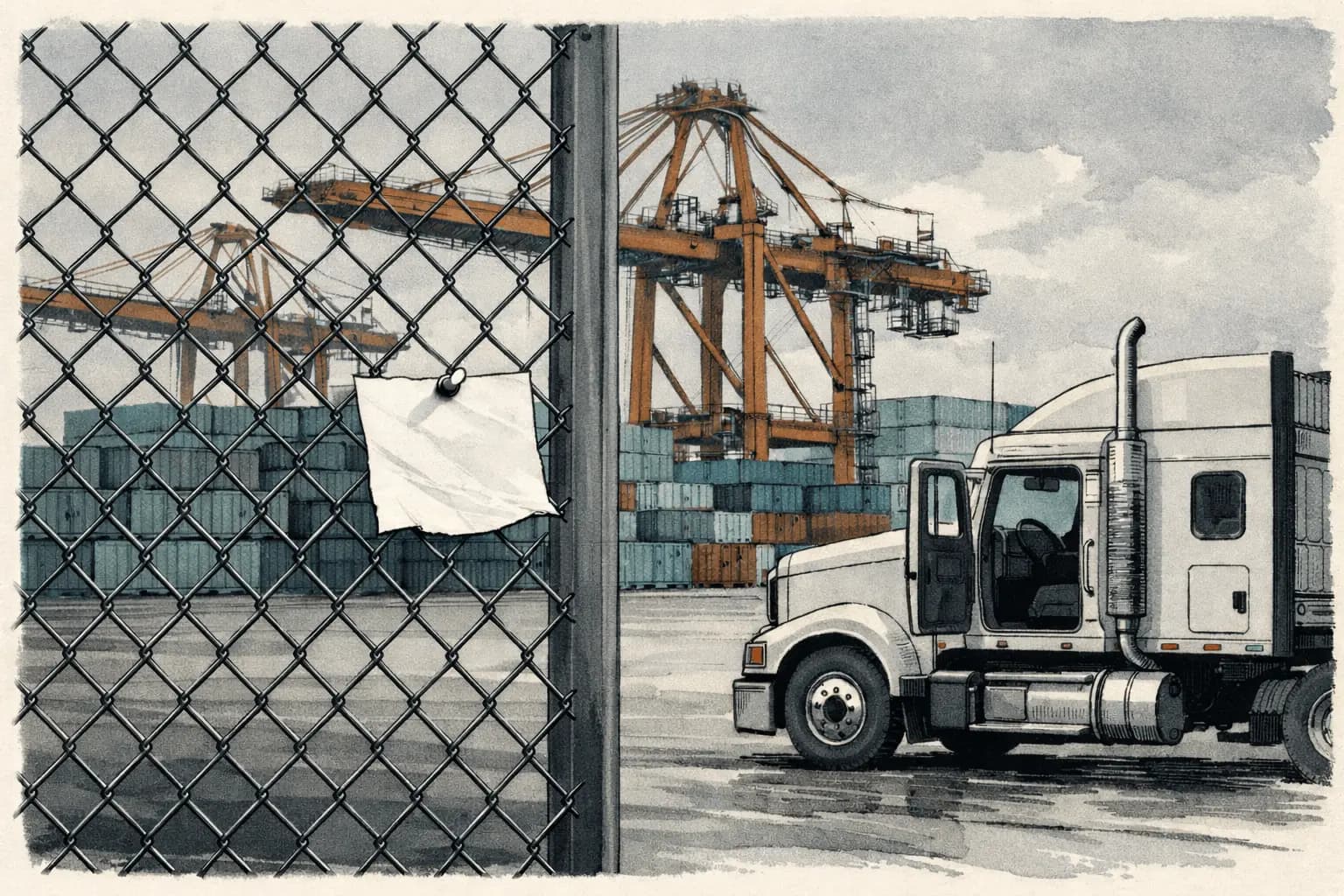
By six in the morning the truck stop on Alameda Street is already three rows deep. Wilmington sits at the wrong end of the 405, where the LA–Long Beach drayage corridor pours into the warehouse belt and the air smells faintly of fuel and the harbor. An owner-operator climbs back into his cab with a coffee and thumbs through his phone. The Department of Labor has proposed a new federal rule on independent contractor classification, and the trade press is paying attention. He keeps scrolling.
AB5 has been settled law for California trucking since June 30, 2022, the day the Supreme Court denied cert in CTA v. Bonta. Whatever Washington does to the federal economic-realities test does not unwind the B prong of California's ABC test. He has known what his classification status was for nearly four years, and a notice in the Federal Register from a different administration is not going to change it. He puts the phone in the door pocket and pulls back onto the truck route.
The proposed rule is being read as if it sets the terms of the classification fight in trucking. In the geographies that move most of America's freight, the fight was already settled at the state level, and the federal rule is moving in the opposite direction from a market that is already tightening for reasons that have nothing to do with the FLSA.
The setup
The Wage and Hour Division published the proposed rule on Feb. 27, 2026, the third federal classification rule in five years. It would replace the 2024 Biden version, which itself replaced the 2021 Trump rule. The six economic-realities factors a federal court uses to decide whether a worker is an employee or a contractor under the Fair Labor Standards Act are not changing. What is changing is how DOL says they should be weighed: lighter language on control, looser treatment of investment and skill, and a tweak to the headline example used to illustrate what counts as control. Where the old rule used a speed limiter as the textbook example, the new draft swaps in a drug-and-alcohol policy. The substance is small. The signal is large.
The signal is what the trade press is reading. OOIDA has cheered parts of it. The American Trucking Associations is supportive of the direction without endorsing every clause. The Teamsters and the plaintiff-side employment bar are alarmed. Comments to docket WHD-2026-0001 close on April 28, and the 2024 rule remains operative until any new rule is finalized, which is unlikely to happen before late 2026 even on an aggressive timeline.
The practical question is simpler. If the rule changes, who actually changes their behavior?
The federal-state split
To answer that, hold three classification regimes side by side.
The federal economic-realities test, which the DOL controls, is a flexible six-factor balancing test administered by DOL inspectors and federal judges. It governs FLSA wage-and-hour exposure. The 2026 swaps would tweak how the factors are weighed and would, on the margin, make it easier for a hiring entity to defend a 1099 classification.
State ABC tests, which apply in California, Massachusetts, New Jersey, Illinois and a handful of others, work on different machinery entirely. To classify a worker as a contractor under an ABC test, the hiring entity must satisfy all three prongs. The B prong, requiring that the work performed be outside the usual course of the hiring entity's business, is the killer for trucking. A motor carrier hires drivers to drive freight. That is the usual course of business, full stop. There is no way to argue around the B prong, which is why CTA v. Bonta took two years and ended with cert denied.
The IRS has its own multi-factor common-law test for federal tax purposes, administered through Form SS-8 determinations. It is independent of the DOL rule and independent of state ABC tests. Carriers can win on FLSA classification and still lose on IRS classification at audit, exposed to back payroll taxes regardless of what any other agency thinks.
Stay close to the market
Get Rig Load Report in your inbox
Weekly freight market analysis, new markets and fresh commentary when it matters.
The federal DOL rule only governs FLSA exposure. It does not touch the IRS analysis, the state ABC tests, or state-led wage-and-hour enforcement. None of the carriers being hit hardest in the current enforcement cycle are being hit by the federal DOL.
The shape of the federal-state mismatch is sharper than that. While the federal DOL is loosening, New Jersey is doing the opposite. NJDOL proposed new regulations in 2025 to tighten its ABC test interpretation further, narrowing the safe harbors and strengthening the presumption of employment. Massachusetts already runs an ABC test stricter than California's. The states with the heaviest drayage and intermodal volumes, the states where most port and cross-border container freight actually moves, are also the states with the most aggressive classification regimes. They are getting more aggressive while Washington gets less.
The cases that have actually moved money over the last three years tell the story. The California Trucking Association spent two years and considerable money trying to get AB5 enjoined and lost. The state's first AB5 trucking enforcement action targeted Mega Nice Trucking, Ryder Last Mile and Costco Wholesale, covering 58 drivers in a single sweep. New Jersey reached a roughly $7 million settlement with PDX North and a $296,000 judgment against Penn Logistics. NJDOL has been issuing stop-work orders against motor carriers on a steady cadence. The state attorney general joined a suit against STG Logistics and STG Drayage in Essex County Superior Court covering more than 300 drivers based at a Newark facility, alleging illegal deductions for fuel, tolls, parking, insurance and vehicle repairs that sometimes exceeded a driver's gross pay for the week.
Those cases were not brought under the federal economic-realities test, and not one of them turns on whether DOL weighs the control factor a quarter-step lighter. The DOL rule sets the floor for FLSA exposure in the states where ABC tests do not apply. In the states where most drayage and port freight moves, it is a sideshow.
The drayage canary
If the federal rule were going to change anyone's behavior, the effect should show up first in drayage. No other segment runs as many 1099s per mile of lane, and no other segment has as much exposure to state ABC enforcement.
Take Newark and Elizabeth. About 9,000 active drayage drivers serve the Port of New York and New Jersey, and roughly 77% of them are owner-operators, according to reporting tied to the STG Drayage business-model shift. That is on the order of 6,930 1099s moving containers in and out of the largest East Coast complex, sitting inside the most aggressive ABC-test jurisdiction in the country. If a regulatory change were going to free up dormant drayage capacity through reclassification mechanics, this is the population where you would see it.
You would not. Drivers who lose state ABC challenges have two paths. They become W-2 employees of the motor carrier, or they move to a different carrier with a structure that does survive the B prong. Most pick the second. The economics of drayage, which run on short hauls, port queue time and chassis costs, push toward the 1099 model, and state law pushes back. The compromise the industry has settled on is a thicket of LLC-to-LLC arrangements, two-check models and leased-on owner-operators with their own operating authority. Those structures are the same regardless of what the federal rule says. A loosening of the federal economic-realities test does not give a Newark drayage carrier a new option that did not exist last week.
LA–Long Beach is the same picture, four years further along. Drayage at the San Pedro Bay ports has been reorganizing around AB5 since 2022. Carriers that were going to exit have exited. Carriers that adapted have adapted. The federal rule is not what is driving the remaining restructurings, and a more permissive federal test is not going to bring back the trucks that left during the freight recession.
If you want to know whether the federal rule matters to drayage, the answer is mostly no. The classification battle in drayage was already fought, and it is being settled at the state level.
The litigation pipeline
The litigation that has moved real money in trucking over the last three years has been state-led, not federal. The PDX North settlement in New Jersey was around $7 million. The Penn Logistics judgment was $296,000. The STG Logistics suit covers more than 300 drivers and the deductions allegedly exceeded gross pay for some of them. The first California AB5 trucking enforcement covered 58 drivers across three named entities. None of these are FLSA cases. They are state wage-and-hour cases, state misclassification cases and state stop-work orders. State attorneys general and state labor departments are running the enforcement calendar. A change in the federal rule does not change their calculus, because they are not operating off the federal rule.
There is one more axis worth flagging. Even a carrier that wins on FLSA classification under the new federal rule can still lose at audit on Form SS-8 determinations. The IRS test is its own machinery, and a model designed around the federal DOL rule alone leaves the carrier exposed on payroll taxes if the IRS decides differently. Carriers that restructure their contractor model based on the proposed rule are taking on two flanks of risk in exchange for closing one.
The freight market read
The rule has to be read against the cycle, and the cycle has just changed.
SONAR's Outbound Tender Reject Index hit 14.46% in March 2026, double its November reading and the highest sustained level since the post-COVID unwind in 2022. National spot rates are running around $2.80 per mile, up roughly 23% year over year. The contract-spot spread compressed from $0.41 a year ago to $0.12 by February and reached near parity by early April. Contract rates are following spot up. As FreightWaves put it on April 9, for the first time in this cycle, demand, pricing pressure and capacity tightening are all moving the same direction at the same time.
Lost in the stack.
What is doing the tightening is not the federal DOL rule. The drivers of capacity contraction are state-level and structural. CDL enforcement and the non-domiciled CDL crackdown have pulled drivers out of the seat. AB5 and NJ ABC enforcement are squeezing 1099 drayage capacity in the lanes that matter most. Post-pandemic fleet right-sizing already pulled excess capacity out of the long-haul market over the back half of 2023 and 2024, and a long tail of small-carrier failures during the freight recession never came back. Right at the moment the federal DOL is loosening one knob on classification, three or four other regulatory and structural knobs are being turned the other way.
That makes the proposal almost incidental to OTRI's trajectory in 2026. A more permissive federal test does not unlock dormant capacity. The 1099 drivers it would arguably benefit are already in the market, just operating under whatever state regime applies in their lane. The rule marginally lowers FLSA tail risk for carriers in non-ABC states, mostly the interior West and South. That is the actual benefit, and it should not be oversold inside a fleet.
How far the tightening runs is a different question, and it has more to do with macro headwinds than with anything DOL publishes. Diesel is elevated again on the back of the Iran situation, and sustained fuel pressure feeds through to consumer demand the longer it lingers. A demand shock hits freight before it hits the classification debate. The path to a 20% OTRI print in 2026, the threshold our OTRI peak market is asking forecasters to call, runs through whether household demand holds up against fuel and policy uncertainty more than through any reclassification mechanic. Capacity is tightening. Whether the tightening turns into a sustained run depends on the macro picture, not on what comes out of the WHD docket.
Even the headline question of whether DOL finalizes this rule in 2026 is uncertain on procedural grounds alone. Comments close April 28. Final rules typically take six to 12 months to publish after a comment period. Litigation will follow whatever DOL puts out. The 2024 rule is operative in the meantime. If you are pricing the DOL finalization market, the calendar is doing more of the work than the substance.
What a fleet manager should do this week
If you operate in a state with an ABC test, the federal proposal is background noise. Your binding constraint is state law and state enforcement, and the more useful thing to watch is the NJDOL docket and the next round of California AB5 enforcement actions. Keep your LLC-to-LLC and two-check arrangements clean, and assume the next stop-work order in your lane will not be triggered by anything published in the Federal Register this spring.
If you operate primarily in non-ABC states, the proposal modestly lowers your FLSA tail risk for 1099 drivers. That is a real but limited benefit. Do not use it as the basis to restructure a contractor model that is working, and do not take on IRS exposure to chase a marginal FLSA improvement. Wait for the final rule, then wait for the litigation that will follow it. Models built around proposed rules tend to age badly.
Everyone else has two practical jobs. File a comment by April 28 if your model is genuinely affected by the language changes; the docket is WHD-2026-0001. And stress-test your bids against the new market, not the old one. The 14.46% OTRI print and contract-spot near parity reset what counts as a defensive bid, and the fuel and demand picture is uncertain enough that bids built for a glut will look thin if the tightening holds. Watch the diesel curve and the next consumer-spending print as carefully as you watch the WHD page.
The frame
The proposed rule is one input among several. State ABC tests, IRS treatment, the underlying freight cycle and the macro picture sitting on top of it are all bigger inputs. The federal rule is moving against the grain of all of them. A more permissive federal test in the middle of a tightening cycle driven by state regulation, structural capacity loss and macro headwinds is a strange thing to organize a 2026 strategy around.
The comment period closes April 28. After that, the calendar takes over: finalization, litigation, another year of the 2024 rule in the meantime. The diesel price and the next consumer-spending print will have moved the freight market three or four times before any of that resolves. Price accordingly.