Open for the fast read before you dive into the full article.
Class 8 net orders surged above year-ago levels throughout 2026, driven primarily by the impending EPA 2027 emissions standards rather than freight market conditions.
The anticipated cost increase for compliance with EPA 2027 standards is influencing fleets to pre-buy, with estimates of price hikes ranging from $15,000 to $30,000 per truck.
Historical patterns indicate that pre-buying leads to a surge in orders followed by a significant drop in deliveries post-implementation of new standards.
The current recovery in the freight market is contributing to pent-up demand, as fleets that previously minimized spending are now re-entering the equipment market.
Pre-buying behavior is not uniform across the industry, with larger fleets more capable of accelerating spending compared to smaller carriers and owner-operators.
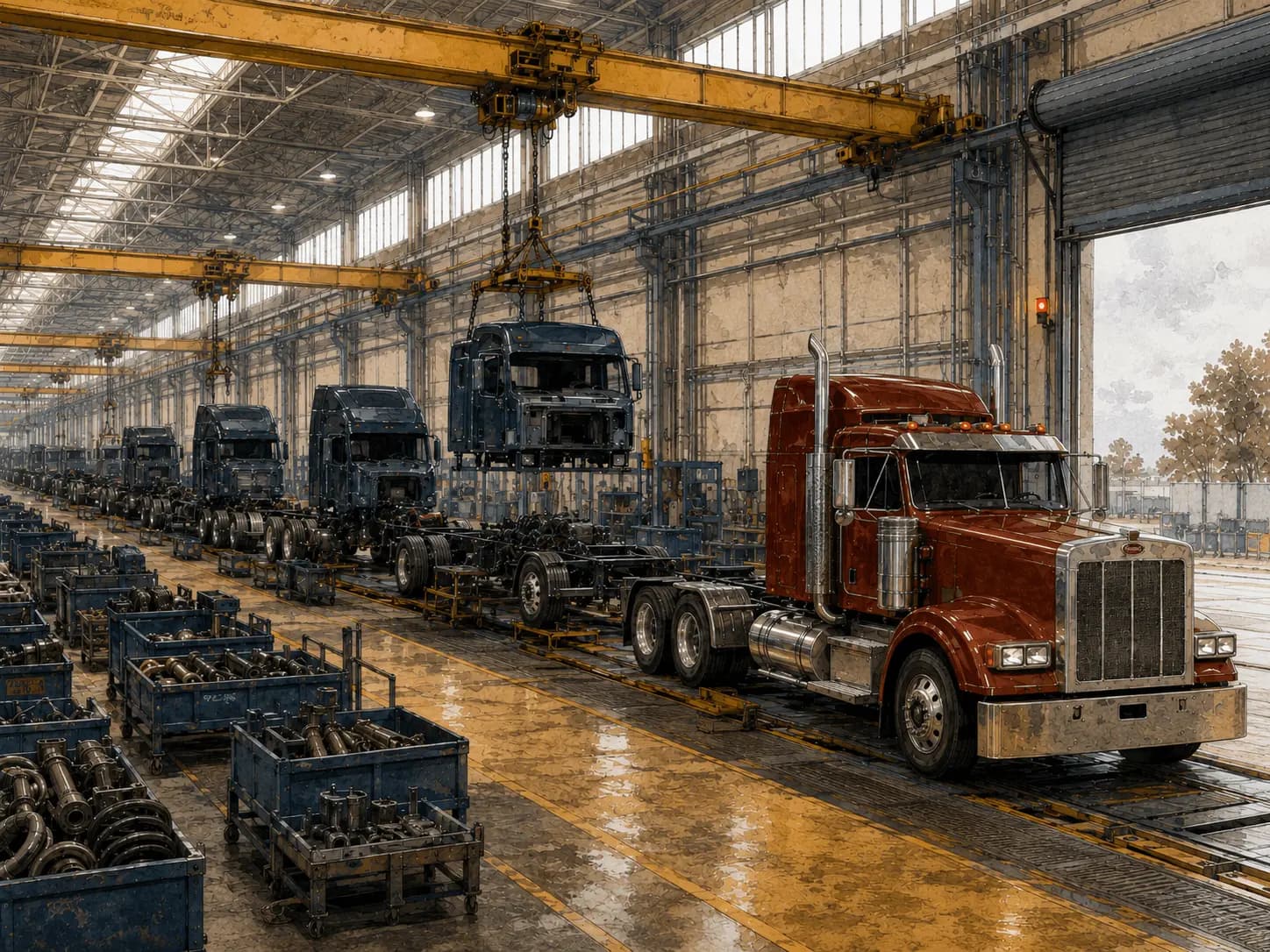
A Class 8 tractor rolling off the line at PACCAR's plant in Chillicothe, Ohio in early May was ordered three or four months ago. The freight market was quieter then. The EPA 2027 emissions deadline was still a year out from the order book's calendar.
The build queue immediately behind it tells a different story. Orders flowing into PACCAR's plant in February, March and into April have run at a cadence the production line, even at full ramp, will spend the rest of 2026 working through.
North American Class 8 net orders have run sharply above year-ago levels every month of 2026. January came in at 30,800 units, up 20% year-over-year. February jumped to 46,200, up 156%. March printed at 38,000, up 126%. April preliminary orders came in at 24,800, lower than March in absolute terms but up 201% from a year earlier. That was the strongest year-over-year jump of the four months, even though April normally marks the start of weak ordering until the September 2026 orderboard opening for 2027 build slots.
EPA 2027 emissions standards are doing most of the work. The freight market's recovery alone wouldn't generate three straight months of triple-digit year-over-year growth on top of a 20% January.
Each order pulled forward into 2026 is borrowed from 2027 or 2028. The cliff side of the cycle has been on the schedule from the start.
Why fleets are racing the calendar
EPA 2027 NOx emissions standards take effect with the 2027 model year and require an 80% reduction in tailpipe NOx, from 200 milligrams per horsepower-hour to 35. The cost of compliance is the part that has the trucking industry's attention. Early estimates put the price increase on a new Class 8 truck at roughly $30,000.
The number is now in motion. EPA is expected to release a notice of proposed rulemaking by late June, and OEMs at the 2026 ACT Expo told carriers that the cost-add could be roughly halved if the rule retains the existing five-year, 100,000-mile warranty for engine emissions systems. International Motors' David Hillman said his read is that the warranty terms hold, which would put the actual price increase at roughly $15,000 per truck rather than $30,000. He also told ACT Expo attendees that "the pre-buy is not expected to be as big for '26 as it was, say, in 2009 or 2006, but it's still expected to stress the industry."
That uncertainty is itself a driver of the surge. Fleets pre-buying in early 2026 weren't waiting for the warranty question to resolve. A hedge against a $30,000 cost-add is more expensive than a hedge against a $15,000 one, but the optionality of placing the order before the rule clarifies still has value, especially for fleets with build slots already at risk.
The historical pattern is consistent. The 2002, 2007 and 2010 EPA cycles all produced a surge-then-crater shape: a year of pull-forward orders ahead of new standards, followed by a sharp drop in deliveries after implementation. The magnitude varied. The shape didn't.
What makes this cycle different is the macro overlay. The 2026 freight market is recovering from a multi-year recession, which means fleets that survived the downturn are reentering the equipment market for the first time in years. There is also a 2025 backdrop: fleets held equipment spending to a minimum through last year amid uncertainty about the rule, tariff disruption and a soft freight market. Some of what's now showing up in the order book is pent-up replacement demand pushed from 2025 into early 2026.
Some of those purchases would be happening in 2026 anyway. But four straight months of year-over-year jumps ranging from 20% to 201%, even with the recovery and the deferred-2025 demand as the baseline, are not normal cyclical buying. Something in the order book is responding to the calendar, not just to freight demand.
ACT framed April's drop from March as the start of "weak order seasonality." The seasonal slowdown is real, and order boards do close for the model year in spring. The reading worth holding onto is what the slowdown is starting from. 24,800 in a soft month is what last year's strong months looked like.
Why a pre-buy is borrowed demand
A pre-buy is a timing reshuffle of equipment-replacement spending. The total fleet investment is the same. A fleet that orders 50 trucks in 2026 instead of 25 in 2026 and 25 in 2027 has the same commitment on its books, just pulled forward.
Historical precedent runs the same way. The 2002 model year EPA cycle produced a small pre-buy in 2001 followed by an order trough in 2002. The 2007 cycle produced a more visible pre-buy in 2006 and a sharp 2007 drop. The 2010 cycle followed the same pattern, though the financial crisis overlapping that period made the pre-buy effect harder to isolate cleanly. The structural mechanics are real and observable across all three.
Stay close to the market
Get Rig Load Report in your inbox
Weekly freight market analysis, new markets and fresh commentary when it matters.
The mechanics of the back end are straightforward. Production schedules built on 2026 demand will run into a smaller forward order book in 2027. OEM hiring patterns lag the order book by six to nine months, which means 2027 OEM workforce decisions are getting made now. The September 2026 orderboard opening for 2027 build slots is the first observable test of how much of the 2027 demand has already been pulled forward.
The 2027 hole is expected. The questions worth caring about are how big it gets and who falls into it.
Who can pre-buy and who can't
A pre-buy isn't a uniform industry behavior. Large fleets with strong balance sheets and access to credit can accelerate equipment spending on a few months' notice. Small carriers and owner-operators coming out of a multi-year freight recession often can't. The 38,000 March order print isn't 38,000 carriers each ordering one truck. It's heavily concentrated among the fleets that have the capital and the financing access to move when an inflection point appears in the calendar.
That asymmetry deepens through the cycle. Large fleets enter 2027 with newer trucks at a lower cost basis. Small carriers enter 2027 needing to buy EPA-compliant trucks at the higher post-rule cost, whether that lands at $15,000 or $30,000, on top of already-stretched balance sheets. They also enter a 2027 used-truck market that has been thinned out by the same large fleets that pre-bought new equipment and held off on trade-ins. The cost-of-capacity gap widens.
The carriers most exposed to operating with older, less-efficient equipment in 2027 and 2028 are the ones who couldn't get an order in ahead of the rule. That is a fixed disadvantage on top of an already-thin operating margin. It has implications for who survives the cycle's back end and who gets consolidated into someone else's network.
A 38,000-unit order print can be both a real signal of a recovering equipment market and an early indicator of a small-carrier squeeze that lands later. Both are true at once.
The cliff side of the cycle
OEMs adjust to the order book. Plants that ramped 2026 capacity to capture the surge will be running below capacity by mid-2027 if the September orderboard opening confirms that the pre-buy has run its course. None of the four major North American Class 8 OEMs has yet announced specific 2027 production cuts. PACCAR, Daimler Truck North America, Volvo Group and Navistar are the names to watch. Whether any of them announces a cut before the end of 2026 is the leading indicator on whether the air pocket arrives on schedule.
For freight, the more interesting question is what a constrained equipment cycle does to capacity overall. New Class 8 trucks are roughly 5% of the operating fleet in any given year, and historical pre-buy cycles have produced 25 to 40% drops in post-implementation deliveries. A drop in that range means less new equipment entering the fleet at the same time small carriers are forced to extend the service life of trucks that should be retiring. Maintenance cycles stretch. The marginal cost of operating a truck rises.
This gets layered onto the 2027 freight demand picture. If 2027 demand is weak, the equipment cycle is a footnote. If 2027 demand is strong, which is the trajectory the rest of the freight market has been mapping, a constrained equipment cycle adds to that pressure.
Another current pointing the same direction
The Class 8 cycle isn't the only freight variable pulling in one direction in 2026. Recent Rig Load Reports have laid out a tightening market from multiple angles. The bid season article on April 18 covered contract rates being negotiated against a market that no longer matches the assumptions the RFPs were built on. The IEEPA refund article on April 24 covered demand-side amplification from refund flows landing on already-tight capacity. The UP-NS merger article last weekend covered modal-shift pressure on east-west long-haul if a single-line transcontinental clears STB.
The Class 8 pre-buy is the equipment-side current in that picture. Each of these analyses points the same direction independently. Rate dynamics, demand amplification, modal competition and equipment availability all compress the same way through 2027. A fleet manager or broker reading any one of them in isolation is underweighting the picture. Read together, the trajectory has multiple reinforcements pointing the same way. That is a different shape than a typical recovery cycle.
The procurement angle
The shipper-side decision is the most asymmetric. A shipper running long-haul on lanes served primarily by mid-sized and small fleets has 2027 carrier-cost exposure that didn't exist a year ago. The carriers most likely to be operating at the higher EPA-compliant equipment cost are the ones least able to absorb it without raising rates. Building optionality into 2026–2027 contracts to account for that is a more defensible procurement decision than assuming current carrier rosters and rate structures hold through the cycle.
For brokers, a small-carrier pool that gets squeezed by the higher equipment cost in 2027 is a different broker market than the one in 2025. Diversification of carrier base matters more than it did. So does evaluating which carriers in the existing book have already pre-bought equipment and which are operating older fleets that will need to be replaced at the higher cost basis.
For OTR carriers running their own equipment, the financing window matters more than the equipment choice itself. 2026 financing rates are what they are. 2027 financing on more expensive trucks is a different conversation, and the carriers that secure equipment financing earlier in the cycle preserve flexibility on the freight side later in it.
The markets and what to watch
The primary anchor is whether 2027 Class 8 net orders exceed 2026 totals. That binary is the cleanest test of the borrowed-demand thesis. If 2027 outperforms 2026, the pre-buy framing was wrong. If 2027 underperforms, the pre-buy was real and the back-end cliff arrived on schedule.
The underlying regulatory question sits behind all of them. Whether EPA 2027 NOx standards take effect without delay determines whether the pre-buy was justified or whether some of the order book ended up paying for a hedge against a smaller cost-add than expected. The late-June NPRM will be the first formal answer.
Two dates to circle. The NPRM in late June will tell the industry what the actual cost-add looks like. The 2027 orderboard opens in September, and the question of how much of the back end has already been pulled forward gets its first observable answer.